
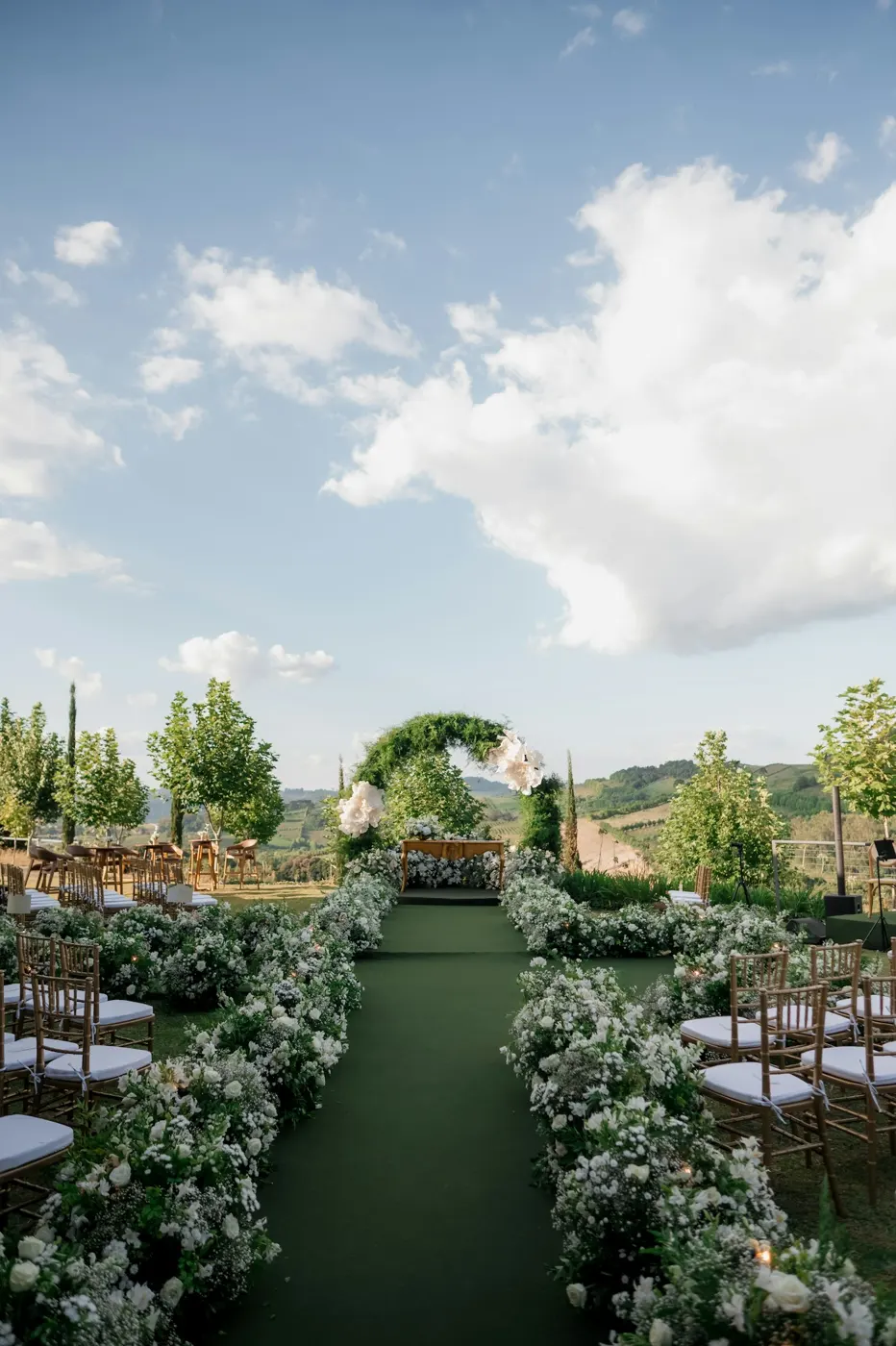
Do grandparents need their own song? Do the parents walk to that same song, or something different? Does the groom walk with his mom, enter with the officiant, or get a moment of his own? And when, exactly, do the groomsmen go?
There are more good answers than most wedding checklists make room for. At Pro DJ's, we've seen ceremony entrances arranged all kinds of ways. My job is not to squeeze your people into somebody else's template. It is to help your music and your entrances feel like they belong together.
For your Abilene wedding, start with who you want to include and how you want the moment to feel. Then we can build the cues around that vision.
Start with the people—not a required order
Write down everyone taking part: grandparents, parents, stepparents, chosen family, the officiant, the wedding party, and any children. Decide who walks with whom, who walks alone, and who would rather already be seated. No one needs to walk the aisle to prove how important they are to you.
Some couples begin with grandparents, then parents, then the wedding party. Others seat family during the prelude—the music playing while guests arrive—and begin the formal processional with the attendants. Both can work.
If a faith or cultural tradition matters to you, talk through its order with your officiant. Vogue's processional guide illustrates just how much entrance traditions vary. An online example is a starting point, not a universal rule.
Songs for parents and grandparents
Family seating can have its own musical moment without feeling like a separate production. A shared song for grandparents and parents often keeps the entrance warm and connected. Two songs—one for grandparents and another for parents—can make sense when you want different tributes or have enough people walking to give each selection room.
Here are a few starting points to listen to together:
- “What a Wonderful World” — Louis Armstrong: a warm, reflective option for honoring family.
- “In My Life” — The Beatles: a meaningful choice when the people who shaped you are the focus.
- “Forever and Ever, Amen” — Randy Travis: a country option if its message connects with your family; an instrumental arrangement is another direction.
- “Canon in D” — Johann Pachelbel: a classical composition available in many recordings, from strings to piano.
You could also use a parent's or grandparent's wedding song. Listen to the complete lyrics and choose the exact recording together; the meaning to your family matters more than a song's place on a wedding list. An instrumental version can keep the melody while changing the feel.
One song or two before the bridal entrance?
When couples ask this, I first clarify what we are counting. Do you mean one song for everyone before the bride or another partner's entrance, or one song for the entire processional? Those are different plans.
Option 1: One shared song for grandparents, parents, and the wedding/bridal party. Everyone enters over one continuous selection, then we change to a separate entrance song for the bride or partner. That is two processional songs total. It can work beautifully for a smaller group or a short aisle.
Option 2: One family song, then one wedding-party song. Grandparents and parents share the first selection; bridesmaids, groomsmen, and other attendants use the second. A separate bridal or partner entrance makes three songs total. This creates a clear musical change between honoring family and bringing in the wedding party.
Option 3: Separate songs for grandparents, parents, and the wedding party. Add the bridal or partner entrance and you have four selections. There is nothing wrong with that if those distinctions matter to you. We will just look at whether each song gets a meaningful moment rather than a few seconds before another switch.
Option 4: One song for the entire entrance. Family, attendants, and the couple can all enter to one piece. We can discuss a change in the arrangement or a specific musical section for your reveal, without requiring a new song. The recording needs enough usable music for your group and aisle.
There is no prize for the most songs—or the fewest. The Knot's ceremony-music guide separates prelude, processional, and recessional music; you do not need to squeeze every ceremony moment into the processional count.
Ring bearers and flower girls can finish the wedding-party song or begin the next entrance section. Agree on that handoff, especially if you want the bridal song to start only when the bride appears. A separate groom song can add another selection; it is optional, too.
When does the groom walk?
The groom does not have to be standing at the front before anyone notices he arrived. He can be, if that is what he wants. Other options include:
- Entering from the side with the officiant and best man as the ceremony begins.
- Walking down the aisle with one or both parents, then helping them to their seats.
- Walking alone before the rest of the wedding party, using the family song, the party song, or a separate personal selection.
- Entering with the groomsmen as a group, or following them for a distinct moment.
- Walking in with his partner instead of having separate entrances.
If he escorts a parent, decide whether he stays at the front afterward or returns to enter again. Either arrangement needs to be intentional. You do not want the next group waiting because nobody knew he was coming back.
When do the groomsmen walk?
Groomsmen can enter from the side with the groom, walk the aisle individually, walk together, or escort bridesmaids or other attendants in pairs. They can precede the groom or follow him. The best man can stay with the groom or have his own place in the lineup.
Pairings do not have to follow gender, relationship status, or perfectly even numbers. Mix the group in the way that feels natural to your people.
If a groomsman is also escorting a grandparent or parent, plan where he goes after seating them. Does he take his ceremony position, or use a side route to return for a paired entrance? That small detail changes both the order and the amount of music needed.
For a shared family-and-party selection, “Here Comes the Sun” by The Beatles offers a bright direction; “Better Together” by Jack Johnson is more relaxed. For a distinct groom or party entrance, “You Are the Best Thing” by Ray LaMontagne can bring some energy. Prefer country, strings, a film score, or a song nobody would find on a wedding playlist? Bring it to us.
Match the cue to the moment—not just the clock
A song title is only half the instruction. Give us the artist, exact version, and the section you love. “Start the song when the doors open” and “open the doors when the chorus arrives” create very different entrances.
For a bridal or partner entrance, selections such as “A Thousand Years” by Christina Perri, “Can't Help Falling in Love” by Elvis Presley, or “From the Ground Up” by Dan + Shay are places to start—not requirements. An acoustic cover may build differently from the original, so listen to the actual recording we will use.
At rehearsal, check walking pace, spacing, aisle length, any stairs, and the time needed to seat family. Children may pause; a grandparent may need an extra moment. People should not have to hurry to rescue a music plan. We can discuss fades, suitable edits, and backup cues beforehand.
Agree on one person to cue entrances and communicate with the DJ. Your coordinator's role includes helping those handoffs happen. The cue should reflect what is happening in front of us, not blindly follow a timestamp.
Plan the final fade—and the first married steps
Decide when the entrance music fades: after you arrive, after an embrace, or once everyone is in position. Then give your officiant a clear moment to begin. Music under a unity ritual is another separate choice; do not assume it should run beneath every spoken word.
For the recessional, agree on the exact cue with the officiant. Is it the kiss, the introduction of the newlyweds, or the moment you turn toward the aisle? We do not want an enthusiastic opening to cover words you hoped to hear. “Signed, Sealed, Delivered (I'm Yours)” by Stevie Wonder or “This Will Be (An Everlasting Love)” by Natalie Cole can give that walk-out a joyful lift.
Have the next music ready while the wedding party and guests leave. Your reception entrance is a different moment with its own energy; our grand-entrance song guide covers that part of the day.
Your day. Your people. Your soundtrack.
Don't let this blog be the end-all, be-all in your decision-making. We've seen it all, and we certainly have recommendations—but ultimately, it's your day! We work for you, and our job is to help make your vision a reality, not talk you into ours.
Want one song where a checklist says three? Want the groom to have a big entrance, both parents beside you, or your whole wedding party walking together? Tell us. We will talk through the details and build a plan around what matters to you.
Bring your ideas to a consultation. You do not need every song or every entrance figured out before we talk. That is what we are here for.
Put your choices on paper with our ceremony music & entrance worksheet (PDF). It includes a music-and-cue page and an entrance lineup, with room for your own plan. Print it or fill it in digitally, then bring it to your consultation.
The Journal, Delivered
Planning a Big Country wedding? Get our best tips in your inbox.
No spam — just new Journal articles and booking-season reminders. Unsubscribe anytime.
Keep Reading
More from the Journal
 Music
Wedding Toasts Without the Marathon: Order, Timing & Mic Tips
 Music
West Texas Weather vs. Your Wedding: The Ultimate Outdoor Sound Strategy
 Music